One physical quantity
Specific resistance is the pressure drop divided by the flow that produced it. It is measured on a constant-flow bench, on a new device, and it does not depend on the flow chosen for the test.
XRS™ scale · technical reference XRS 001:2026
Standards cap the breathing resistance of a mask; none grades it. The XRS scale turns one bench measurement — specific resistance — into six levels, X1 to X6, each with a breathing endurance a buyer can read on the pack and compare between brands.
The six levels
Specific resistance Rs in Pa/(L·s⁻¹), measured on a new respirator. Breathing endurance is what the resistance permits — always within the manufacturer's stated conditions of use.
What the scale is
Every level is a good level for some use. A mask at X5 is the right choice for a short task in a loaded atmosphere; a mask at X1 is the right choice for a child or for sleep. The scale reports a position on an axis — it does not rank products as good or bad.
Specific resistance is the pressure drop divided by the flow that produced it. It is measured on a constant-flow bench, on a new device, and it does not depend on the flow chosen for the test.
30, 60, 100, 140 and 200 Pa/(L·s⁻¹). None is set by convention: the central boundary is the psychophysical detection threshold of added inspiratory resistance, the upper ones are the resistance ceilings of the filtration classes.
The XRS level qualifies breathing comfort. It says nothing about filtration efficiency, and it never appears next to a protection class in the same block. A mask can be X2 and highly filtering, or X5 and poorly filtering.
Who it is for
Scan the code on the pack, or open the page of the level: what the level means, how long the resistance permits, and what the level does not say.
Level pages X1 to X6Two FFP2 masks that both comply can differ by a factor of three in resistance. The level gives an opposable criterion, expressed in the unit of the decision: the wearing duration that is actually sustainable.
Use profiles and tablesLowering the pressure drop of a compliant product is invisible on a pack today. The XRS marking turns a test-report line into a shelf argument — under a licence with quality control and a public register.
Licence and price listThe construction, the fifteen-marker consistency test, the ISO 16976-4 conformity check and the pre-registered validation protocol are published in full. The scale is falsifiable by design, and it invites contradiction.
Method, evidence and limits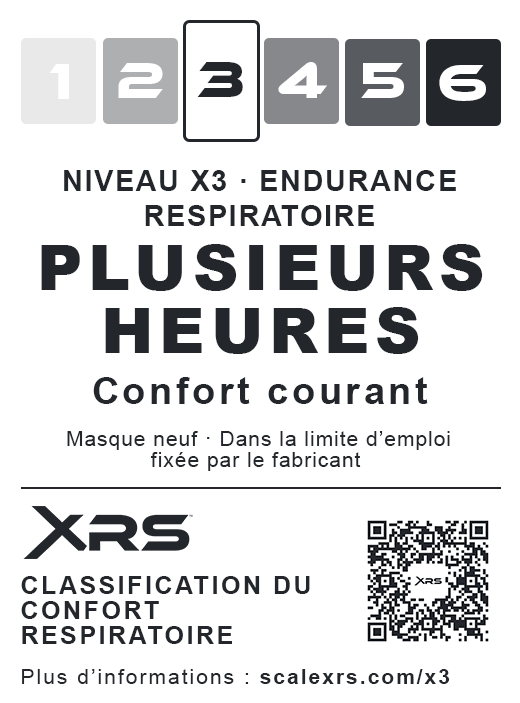
On the pack
The XRS panel is the same object on every licensed product, at the same dimensions, so that three boxes of three brands compare on the shelf without reading a word.
Economic model
Anyone may read, cite, redistribute and apply XRS 001:2026, in design as in research, without asking. Printing "XRS level X2" on a product requires a licence, because a mark without effective quality control means nothing — and, in several jurisdictions, ceases to exist.
Set at the full cost of instruction and surveillance with a 15 % safety margin and no profit on the declaration right. Identical for every applicant; degressive on an objective criterion only.
Controlled self-declaration, third-party test, or XALPES certification. Whatever the regime, every declaration is instructed, entered in the public register and monitored.
The declaration right is waived for every declaration registered before that date, and for research, teaching and scientific publication at any time. Only the test is invoiced.
XRS 001:2026 is a proprietary technical reference published under the sole responsibility of XALPES LLC. It is not a standard, has no regulatory value, does not classify filtration efficiency and does not authorize any regulated use. The human-panel validation described in its Clause 14 has not yet been conducted; its success criteria and its refutation conditions are published in advance. The reference is open to comment.